

 https://www.rapinteriors.co.uk/wp-content/uploads/2021/02/concrete-vinyl-tiles-office-flooring-750x563.jpg
Concrete vinyl tiles used as durable office flooring option in industrial interior design scheme
https://www.rapinteriors.co.uk/wp-content/uploads/2021/02/concrete-vinyl-tiles-office-flooring-750x563.jpg
Concrete vinyl tiles used as durable office flooring option in industrial interior design scheme
At this very moment, there are seas of office desks lying dormant across the UK. The pandemic has dramatically changed the way we work, resulting in questions being asked over the role of the office in the future.
A year on from the first lockdown, we have seen a number of developments in the office design world that give insight into what the future may hold. These range from how we approach working practices to how the office impacts employee wellbeing.
In this blog, we look at some of those developments and how they are shaping the office of the future. Read on for our five predictions…
 https://www.rapinteriors.co.uk/wp-content/uploads/2020/12/london-office-refurbishment-project-completed-750x563.jpg
A London office refurbished by Rap Interiors as a breakout space
https://www.rapinteriors.co.uk/wp-content/uploads/2020/12/london-office-refurbishment-project-completed-750x563.jpg
A London office refurbished by Rap Interiors as a breakout space
 https://www.rapinteriors.co.uk/wp-content/uploads/2020/03/Office-design-and-fit-out-project-in-St-Albans-London-750x499.jpg
Office-design-and-fit-out-project-in-St-Albans-London
https://www.rapinteriors.co.uk/wp-content/uploads/2020/03/Office-design-and-fit-out-project-in-St-Albans-London-750x499.jpg
Office-design-and-fit-out-project-in-St-Albans-London
 https://www.rapinteriors.co.uk/wp-content/uploads/2019/05/hudl-office-design-and-fit-out-london-from-rap-interiors-3-750x500.jpg
breakout area for the hudl office fit out in london
https://www.rapinteriors.co.uk/wp-content/uploads/2019/05/hudl-office-design-and-fit-out-london-from-rap-interiors-3-750x500.jpg
breakout area for the hudl office fit out in london
It can be said that businesses will learn some valuable lessons from the pandemic. Addressing how physical and mental health has been impacted due to COVID-19 is shaping future workplace wellbeing.
With a wealth of statistics out there also showing that addressing staff wellbeing can reap financial rewards for businesses, there’s no doubt that everyone will benefit from a pro-wellbeing approach. Here are a few considerations:
The pandemic has brought the subject of indoor air quality to light, so we expect to see more companies addressing this in their workspaces. With 80% of employees saying that poor air quality negatively affects their health, it’s something that shouldn’t be ignored.
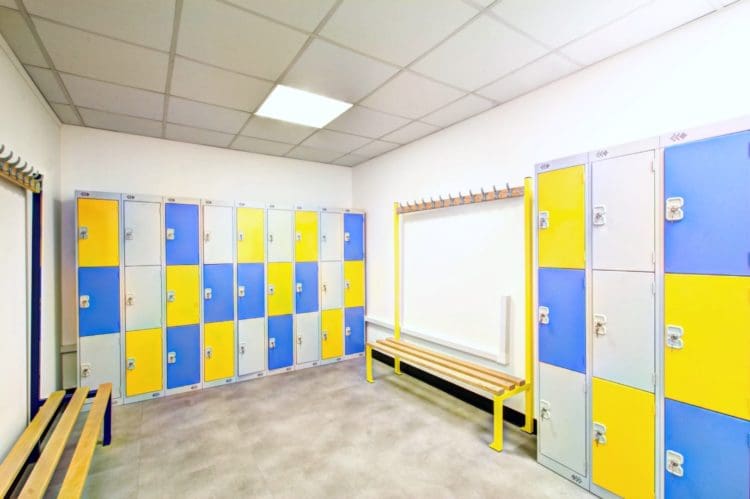
With more people walking and cycling during the pandemic, businesses will benefit from offering exercise-enabling spaces. Whether it be introducing bike storage or a small on-site gym, employees will be thankful of spaces where the can catch some endorphin-boosting exercise. In Google’s case, its new London HQ is equipped with a 25-metre swimming pool and basketball court!
One big takeaway from our blog was that many employees have found that home working has had a negative impact on their mental health. Despite this, many want to alternate their time between the home and office in the future. This again points towards a more flexible model, where employees can enjoy the autonomy of home working while using the office for collaborative tasks.
 https://www.rapinteriors.co.uk/wp-content/uploads/2019/05/a-staff-changing-room-with-lockers-and-benches-created-by-refurbishment-company-rap-interiors-750x499.jpg
a staff changing room with lockers and benches created by refurbishment company rap interiors
https://www.rapinteriors.co.uk/wp-content/uploads/2019/05/a-staff-changing-room-with-lockers-and-benches-created-by-refurbishment-company-rap-interiors-750x499.jpg
a staff changing room with lockers and benches created by refurbishment company rap interiors
 https://www.rapinteriors.co.uk/wp-content/uploads/2021/04/collaborative-workspace-in-open-plan-office-design-750x563.jpg
collaborative workspace in open plan office design
https://www.rapinteriors.co.uk/wp-content/uploads/2021/04/collaborative-workspace-in-open-plan-office-design-750x563.jpg
collaborative workspace in open plan office design
 https://www.rapinteriors.co.uk/wp-content/uploads/2020/12/microsofts-branding-colours-office-interior-design-750x562.jpg
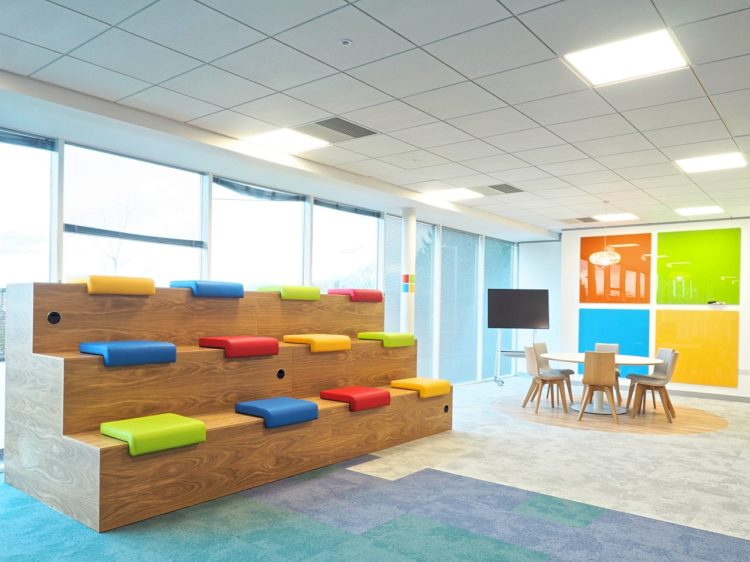
Bleacher seating with Microsoft branding coloured seat pads in an office breakout area
https://www.rapinteriors.co.uk/wp-content/uploads/2020/12/microsofts-branding-colours-office-interior-design-750x562.jpg
Bleacher seating with Microsoft branding coloured seat pads in an office breakout area
 https://www.rapinteriors.co.uk/wp-content/uploads/2019/11/The-Pick-Everard-London-office-fit-out-in-Holborn-750x500.jpg
The Pick Everard London office fit out in Holborn
https://www.rapinteriors.co.uk/wp-content/uploads/2019/11/The-Pick-Everard-London-office-fit-out-in-Holborn-750x500.jpg
The Pick Everard London office fit out in Holborn
We’ve already mentioned how some offices will likely take on a new role due to a rise in flexible working. For some businesses, this will mean that there will be some space left over to play with. The question for those companies will be “how can that space be optimised”?
For some, one solution will be to “sub-let”, where a portion of the office is let out to another company. This requires permission from the landlord and, if granted, can be a shrewd way of optimising the extra space.
Others may simply keep the space to themselves but hire a refurbishment company to create an agile environment that helps employees to perform and feel connected. This is a bold departure from the traditional model of squeezing as many people onto one floorplate to control costs, but in doing so businesses may benefit from the greater output from staff.
Many businesses are also redefining the role of their front of house space and team and the purpose of a front of house operation is up for debate.
A survey by the Institute of Workplace and Facilities Management shows 57% of businesses are implementing new technology to help with the front of house duties while 35% are reducing the size of their teams as a result of COVID-19.
While it’s still extremely important for receptionists to greet visitors and manage the switchboard, COVID-19 has sped up decision-making to implement new technology which in turn will influence the design of the reception area in many workplaces.
 https://www.rapinteriors.co.uk/wp-content/uploads/2019/05/commercial-interior-design-with-shared-desks-and-mesh-back-chairs-14-750x499.jpg
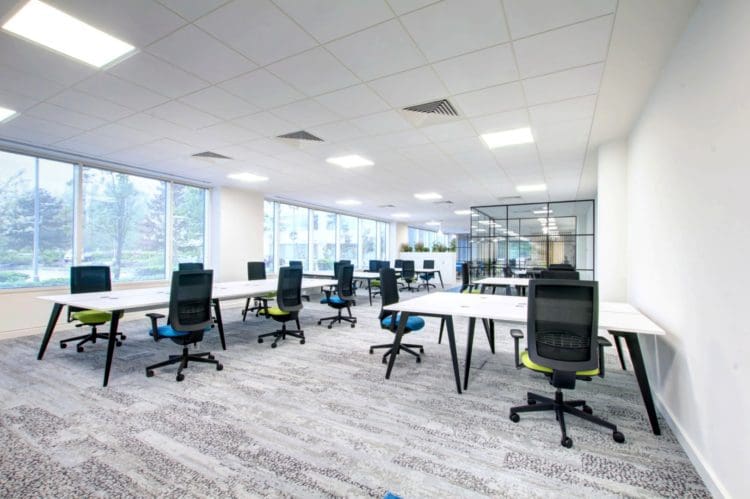
commercial interior design with shared desks and mesh back chairs
https://www.rapinteriors.co.uk/wp-content/uploads/2019/05/commercial-interior-design-with-shared-desks-and-mesh-back-chairs-14-750x499.jpg
commercial interior design with shared desks and mesh back chairs
While nobody has a crystal ball, the developments we have seen 12 months have enabled us to gain a better picture as to what the future will hold for office space.
Already we can see that there are plenty of exciting changes going on, indicating that the future of the office looks bright for businesses and staff alike.
As refurbishment contractors, we’re looking forward to seeing — and being a part of — further developments as we move closer to a post-COVID world.
Are You Planning a Refurbishment Project?
If you’re making plans for the great return to work and need a cutting-edge refurbishment company, then Rap Interiors can help.
With a team of dedicated design and project experts and over 30 years’ experience, we can optimise your space to ensure it is safe, practical and equipped for future operations.
To book a free consultation with one of the leading refurbishment companies in the UK, call 0333 600 1234 or email refurb@rapinteriors.co.uk.
https://www.rapinteriors.co.uk/wp-content/uploads/2020/12/london-office-refurbishment-project-completed-750x563.jpg
A London office refurbished by Rap Interiors as a breakout space