
 https://www.rapinteriors.co.uk/wp-content/uploads/2026/01/Office-design-ideas-to-prevent-work-burnout-750x500.jpg
Office design ideas to prevent work burnout.
https://www.rapinteriors.co.uk/wp-content/uploads/2026/01/Office-design-ideas-to-prevent-work-burnout-750x500.jpg
Office design ideas to prevent work burnout.
As defined by Collins Dictionary, burnout is a “total loss of energy and interest and an inability to focus effectively, experienced as a result of excessive demands on one’s resources or chronic overwork.”
Not only is this bad for the individual, but data suggests that it has a negative effect on businesses too. Here are some eye-opening statistics:
If that wasn’t bad enough, Deloitte now estimates that presenteeism outweighs the cost of absenteeism. This means employees producing a low standard of output have bigger cost implications than those who aren’t present at all.
Clearly, this is a huge problem for businesses globally. But what can be done about it?
People tend to prioritise their health at the start of the year, so why not continue this trend in the workplace?
As an office interior design company, we believe the workplace setup can play a key role in addressing burnout. While good company culture is very important too, combining it with an employee-centric office environment is the ideal scenario.
We’ll leave the company culture part to you, but from us, here are some office design ideas to help you prevent employee burnout…
Related content: Office Interior Design Ideas 2026
 https://www.rapinteriors.co.uk/wp-content/uploads/2026/01/Biophilic-feature-walll-with-neon-sign-encouraging-calm-at-work-750x500.jpg
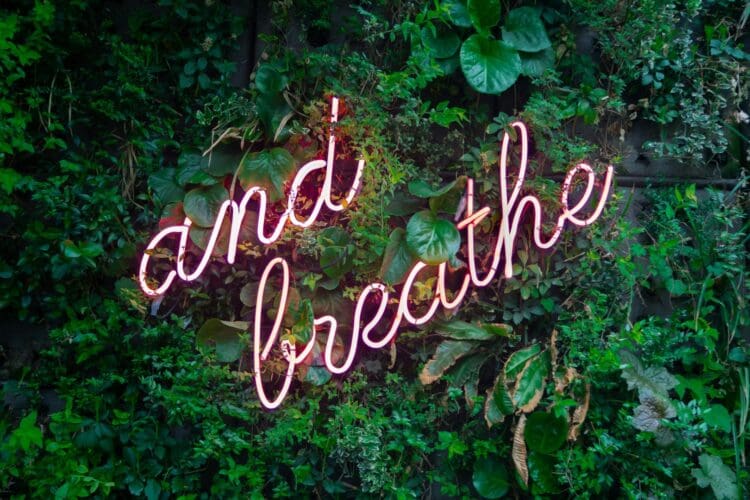
Biophilic feature walll with neon sign encouraging calm at work.
https://www.rapinteriors.co.uk/wp-content/uploads/2026/01/Biophilic-feature-walll-with-neon-sign-encouraging-calm-at-work-750x500.jpg
Biophilic feature walll with neon sign encouraging calm at work.
Smart office systems can actively monitor and adjust the workplace environment to support human biology. By integrating this responsive technology, businesses can create human-centric environment which, in turn, helps to prevent burnout.
Here are some examples of how smart office systems work:
As the examples suggest, smart technology will provide subtle benefits. While employees may not actively notice changes to CO2 levels or colour intensity, they will undoubtedly feel more energised and focused as a result.
 https://www.rapinteriors.co.uk/wp-content/uploads/2024/07/Corporate-meeting-room-with-sliding-wall-in-office-refurbishmnet-project-in-Kent-750x500.jpg
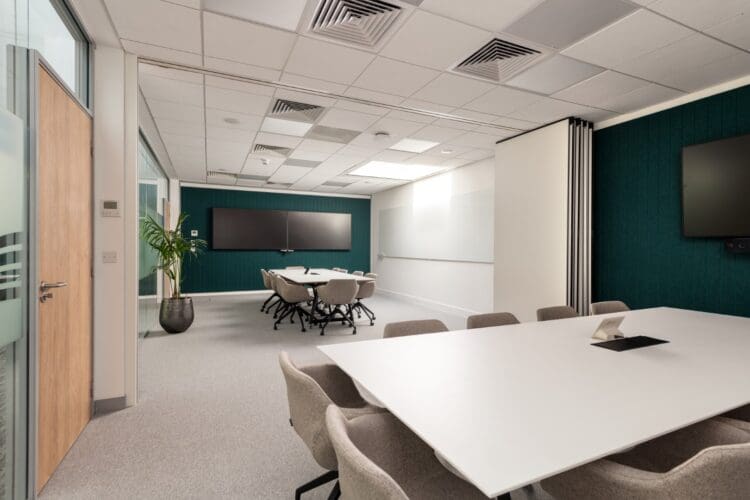
Corporate meeting room with sliding wall in office refurbishment project in Kent.
https://www.rapinteriors.co.uk/wp-content/uploads/2024/07/Corporate-meeting-room-with-sliding-wall-in-office-refurbishmnet-project-in-Kent-750x500.jpg
Corporate meeting room with sliding wall in office refurbishment project in Kent.
As highlighted by wellbeing coach Bianco Errigo in Startups Magazine, burnout isn’t always caused by overwork. It can also stem from under-fulfilment and lack of purpose.
As she suggests, generic initiatives like gym memberships are not enough, which is why she advocates for a data-driven approach combined with personal coaching. This coaching focuses on aligning individual goals with organisational objectives.
For this reason, it’s good to have a dedicated private space for one-to-ones and coaching. One way to do this is to introduce a sliding acoustic wall like the one in the image above. Specified by our Kent interior designers for a project in Kings Hill, the wall allows our client to easily create a temporary private room.
For more on this topic, check out our article on Maslow’s Hierarchy of Needs.
 https://www.rapinteriors.co.uk/wp-content/uploads/2024/06/Internal-space-of-office-pod-for-hybrid-working-Large-750x1000.jpg
Internal space of office pod for hybrid working.
https://www.rapinteriors.co.uk/wp-content/uploads/2024/06/Internal-space-of-office-pod-for-hybrid-working-Large-750x1000.jpg
Internal space of office pod for hybrid working.
 https://www.rapinteriors.co.uk/wp-content/uploads/2024/06/Office-hybrid-working-pods-with-glass-walls-in-office-refurbishment-project-Large-750x563.jpg
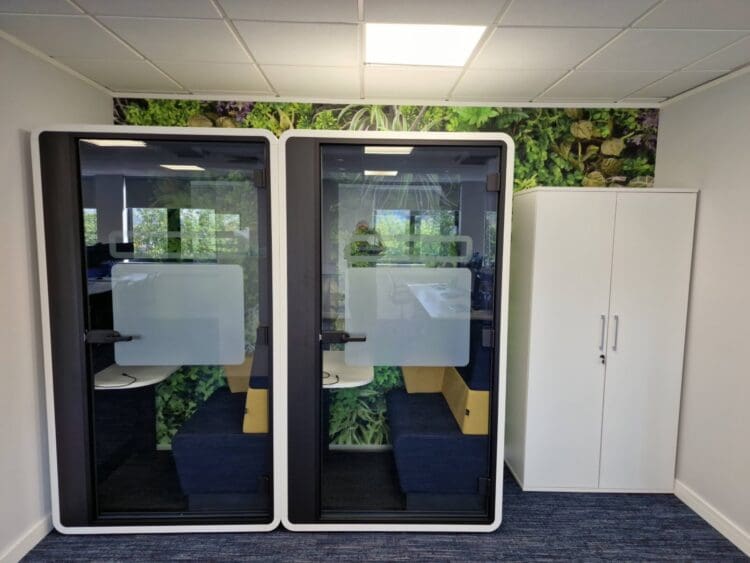
Office hybrid working pods with glass walls in office refurbishment project. Rap Interiors
https://www.rapinteriors.co.uk/wp-content/uploads/2024/06/Office-hybrid-working-pods-with-glass-walls-in-office-refurbishment-project-Large-750x563.jpg
Office hybrid working pods with glass walls in office refurbishment project. Rap Interiors
*Note that the images above are not from the Brain Booth brand, but pods from our office fit out project in Southampton.
Every year, entrepreneurs show off their latest inventions at the Consumer Electronics Show (CES). Many of these inventions are helping to shape the future of work, including the new ‘Brain Booth’ with AI Coach.
The Brain Booth is a compact, AI-powered wellness pod that uses posture and heart-rate sensors to read a worker’s cognitive and physical state in real time. When focus or stress levels rise, the booth adjusts lighting, sound, oxygen flow and binaural beats to support attention or recovery.
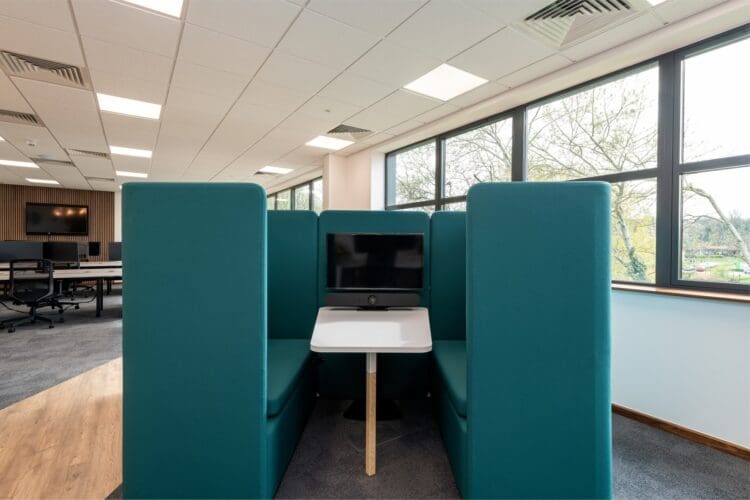
While the Brain Booth sounds like a fantastic addition for any business’s space, standard acoustic pods are also great too. These offer an isolated private space for quiet work, allowing employees to escape distractions and double down on a task.
 https://www.rapinteriors.co.uk/wp-content/uploads/2023/06/Albion-Fine-Foods-49-Large-750x500.jpg
Acoustic meeting booth in an office interior design and fit out for a food supply company in Kent.
https://www.rapinteriors.co.uk/wp-content/uploads/2023/06/Albion-Fine-Foods-49-Large-750x500.jpg
Acoustic meeting booth in an office interior design and fit out for a food supply company in Kent.
 https://www.rapinteriors.co.uk/wp-content/uploads/2023/06/Albion-Fine-Foods-58-Large-750x500.jpg
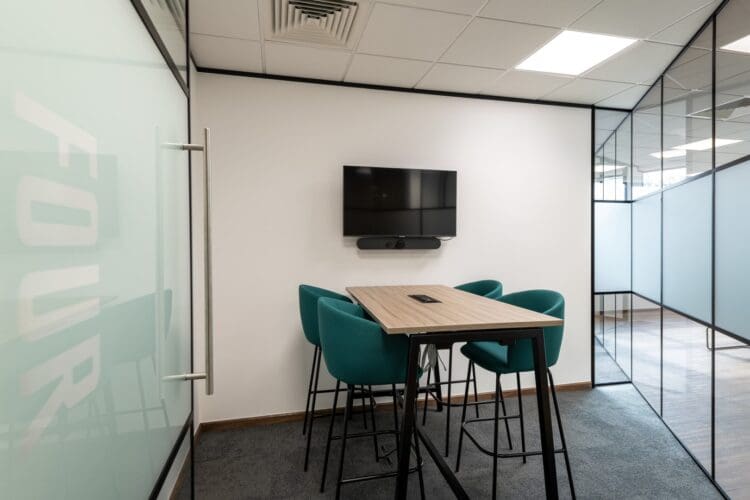
Meeting room design with poseur height collaboration table and stools.
https://www.rapinteriors.co.uk/wp-content/uploads/2023/06/Albion-Fine-Foods-58-Large-750x500.jpg
Meeting room design with poseur height collaboration table and stools.
Decades of research show that when jobs include positive characteristics like autonomy, employees are more satisfied and perform better. Furthermore, minimising negative work characteristics like excessive time pressure is key in preventing burnout.
Given that lack of autonomy and over-supervision are linked to burnout, it makes sense to create an environment where employees feel at ease. The greater their sense of agency, the better.
From an office design perspective, offering employees a choice of work zones and workstations can help to support autonomy. Rather than restricting them to a single desk all day, you can provide alternatives like laptop lounges, quiet zones, acoustic pods and standing desk areas.
This will give employees the freedom to move around and feel less restricted, making work more relaxed and productive.
Related case study: Check out Hudl’s ‘activity-based’ London office here.
 https://www.rapinteriors.co.uk/wp-content/uploads/2024/06/Large-office-meeting-room-design-with-acoustic-ceiling-tiles-and-office-furniture-solutions-Large-750x563.jpg
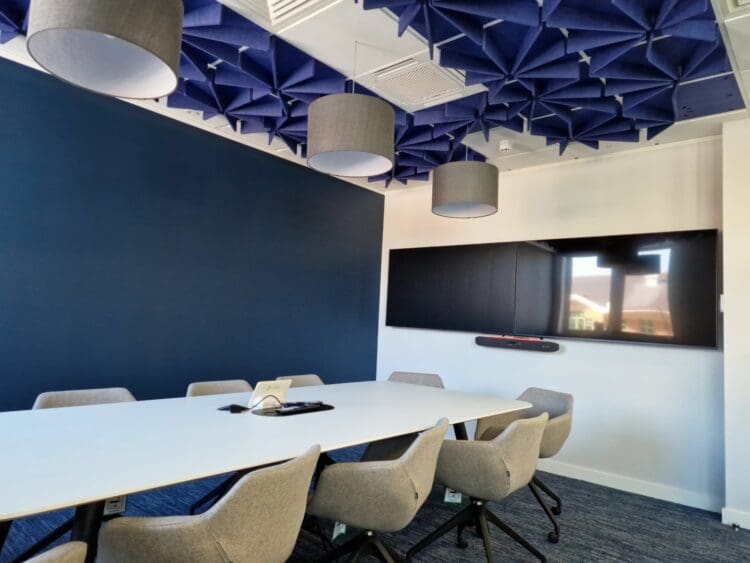
Large office meeting room design with acoustic ceiling tiles and office furniture solutions.
https://www.rapinteriors.co.uk/wp-content/uploads/2024/06/Large-office-meeting-room-design-with-acoustic-ceiling-tiles-and-office-furniture-solutions-Large-750x563.jpg
Large office meeting room design with acoustic ceiling tiles and office furniture solutions.
 https://www.rapinteriors.co.uk/wp-content/uploads/2024/07/Corporate-office-meeting-room-with-modern-furniture-solutions-and-feature-acoustic-pendants-750x500.jpg
Corporate office meeting room with modern furniture solutions and feature acoustic pendants.
https://www.rapinteriors.co.uk/wp-content/uploads/2024/07/Corporate-office-meeting-room-with-modern-furniture-solutions-and-feature-acoustic-pendants-750x500.jpg
Corporate office meeting room with modern furniture solutions and feature acoustic pendants.
 https://www.rapinteriors.co.uk/wp-content/uploads/2023/06/Crittall-glass-partition-for-meeting-room-apart-of-the-new-refurbishment-and-fit-out-for-Albion-Fine-Foods-in-Dartford-Kent-750x500.jpg
Crittall glass partition for meeting room apart of the new refurbishment and fit out for Albion Fine Foods in Dartford Kent.
https://www.rapinteriors.co.uk/wp-content/uploads/2023/06/Crittall-glass-partition-for-meeting-room-apart-of-the-new-refurbishment-and-fit-out-for-Albion-Fine-Foods-in-Dartford-Kent-750x500.jpg
Crittall glass partition for meeting room apart of the new refurbishment and fit out for Albion Fine Foods in Dartford Kent.
When an office is noisy and distracting, it will invariably lead to employees with heavy workloads and tight deadlines feeling stressed. As they battle to try and get their work done, they will feel exhausted by the end of the day, potentially resulting in long-term burnout if it is a regular occurrence.
There are numerous ways to combat this. First and foremost, you should provide dedicated focus areas in the office where employees can retreat and double down on a task. These can be private rooms situated away from the main office thoroughfare or even individual pods for a place of refuge.
The next thing to consider is acoustic elements. To prevent noise from travelling, introduce sound-absorbing materials like acoustic panels, quality carpets and ceiling baffles. Soft furniture can also help to reduce noise while offering a quiet, comfortable place for laptop work, helping to enhance wellbeing (as demonstrated above).
These elements will lead to a calmer, more productive environment and, crucially, help employees to avoid burnout!
In addition to functional aspects like acoustics and quiet zones, consider how your office interior decorations will tie in with those elements.
For example, one subtle way to send an anti-burnout, pro-wellness message to employees is through a calming colour scheme. Pantone’s Colour of the Year, Cloud Dancer, is ideal for this, as it’s said to encourage “true relaxation and quiet focus for those seeking moments of disconnection.”
Based on the description from Pantone Vice President Laurie Pressman, Cloud Dancer would be a great addition to a dedicated quiet area.
 https://www.rapinteriors.co.uk/wp-content/uploads/2023/10/Hudl-26-Large-750x500.jpg
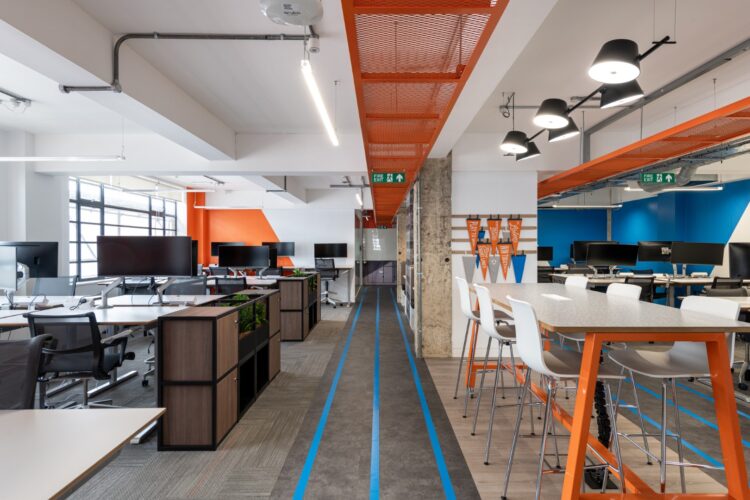
London office refurbishment with modern office furniture solutions.
https://www.rapinteriors.co.uk/wp-content/uploads/2023/10/Hudl-26-Large-750x500.jpg
London office refurbishment with modern office furniture solutions.
Do you ever feel the urge to get up and move around during work? Stillness breeds burnout, so setting up your office to encourage physical movement can help prevent tiredness.
One way to do this is to create walking paths, like Hudl did as part of its London office refurbishment. This is a great way to encourage employees to get some steps in! Note how there are also sit-stand desks in the picture, which break up sedentary, static postures throughout the day.
For an outside the box idea, you could also integrate a ‘stretch corner’ in a quiet area of the office. With some calming biophilia and yoga mats, you could have the most flexible team in town!
Ultimately, ignoring the signs of burnout while keeping your office environment the same is a recipe for low productivity. If employees are simply “powering through”, it will have a negative impact on their performance and the wider business.
By designing an employee-centric office that actively addresses burnout, you can help them to thrive. From allowing more worker autonomy to creating quiet private office spaces to supporting personal development, these changes can have a significant impact.
In fact, in today’s competitive landscape where many employees feel overworked and exhausted, the anti-burnout office could be a secret weapon for sustainable growth.
Ready to Create a Burnout Proof Office? Don’t let productivity dip before making a change. Our expert office interior designers can help you integrate the elements featured here and much more.
To book a design consultation, please fill out the enquiry form below or email refurb@rapinteriors.co.uk.
Enter your details below and one of the team will contact you to discuss your requirements.
 https://www.rapinteriors.co.uk/wp-content/uploads/2022/01/Office-boardroom-interior-design-for-a-Kent-property-developer-750x1125.jpg
Workspace interior design with acoustic elements
https://www.rapinteriors.co.uk/wp-content/uploads/2022/01/Office-boardroom-interior-design-for-a-Kent-property-developer-750x1125.jpg
Workspace interior design with acoustic elements