

 https://www.rapinteriors.co.uk/wp-content/uploads/2025/09/Future-workspace-design-ideas-750x500.jpg
Future workspace design ideas with future office design trends.
https://www.rapinteriors.co.uk/wp-content/uploads/2025/09/Future-workspace-design-ideas-750x500.jpg
Future workspace design ideas with future office design trends.
As office fit out contractors, we’ve seen the workplace evolve rapidly in recent years. While there is still a place for traditional office layouts and designs, it’s clear that businesses are doing more to attract and retain employees.
Indeed, office designs are becoming more sophisticated and nuanced, with employee wellbeing and satisfaction largely driving the change. From introducing enticing amenities to offering a variety of work settings, the modern office is arguably better than ever when it comes to employee experience.
Given the rapid changes, it begs the question, what will we see next? In this blog, we answer that question by looking at recent workplace studies and burgeoning trends. We’ll also reference our projects to give you a well-rounded insight into what tomorrow could bring.
Related content: Office Interior Design Trends 2025
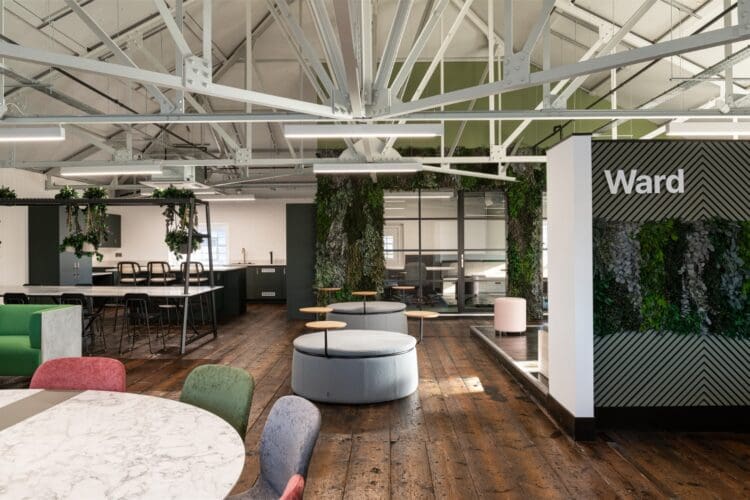 https://www.rapinteriors.co.uk/wp-content/uploads/2024/01/Biophilic-feature-wall-in-office-interior-design-project-for-Ward-Security-Kent-750x500.jpg
Biophilic feature wall in office interior design project for Ward Security, Kent.
https://www.rapinteriors.co.uk/wp-content/uploads/2024/01/Biophilic-feature-wall-in-office-interior-design-project-for-Ward-Security-Kent-750x500.jpg
Biophilic feature wall in office interior design project for Ward Security, Kent.
According to Worktech Academy, there has been a rise in blue chip companies moving to ‘heritage’ buildings. Among those companies is Apple, which has recently settled into Battersea Power Station in London. Likewise, Google has invested in a ‘heritage’ workspace at the end point of the High Line in New York.
So, why is there a trend towards businesses investing in older spaces? According to research from the Netherlands, the connection to the past increases employee motivation and creates a sense of identity. This is due to the authenticity and uniqueness of the spaces – something which new commercial offices can’t replicate.
We’ve seen this office fit out trend amongst our own clients too. For example, Ward Security opted for an office at the Historic Dockyard in Chatham, which was central to Britain’s success at sea during the 18th and 19th centuries. The existing structure included historic features like exposed brickwork, timber beams, metal trusses and original timber floors with carpenter marks.
Related project: Ward Security
Related content: An Introduction to Office Retrofitting
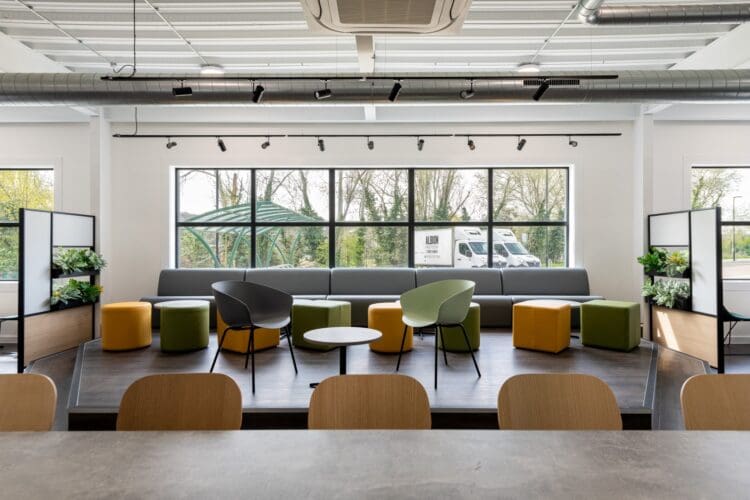 https://www.rapinteriors.co.uk/wp-content/uploads/2023/06/Albion-Fine-Foods-Banquet-Seating-with-Coffee-Tables-750x500.jpg
Elevated seating area with banquet seating and coffee tables. Complimentary branding colours.
https://www.rapinteriors.co.uk/wp-content/uploads/2023/06/Albion-Fine-Foods-Banquet-Seating-with-Coffee-Tables-750x500.jpg
Elevated seating area with banquet seating and coffee tables. Complimentary branding colours.
 https://www.rapinteriors.co.uk/wp-content/uploads/2023/11/Office-refurbishment-project-in-London-with-height-adjutable-desks-and-company-branding-1-750x500.jpg
Office refurbishment project in London with height adjustable desks and company branding.
https://www.rapinteriors.co.uk/wp-content/uploads/2023/11/Office-refurbishment-project-in-London-with-height-adjutable-desks-and-company-branding-1-750x500.jpg
Office refurbishment project in London with height adjustable desks and company branding.
According to a new industry report, called Tomorrow’s Office (supported by Knauf), the modern workplace must be flexible enough to respond to constantly changing needs. Such changes include fluctuating staff numbers due to hybrid work, changes in company structure, or growth and contraction.
As such, it is predicted that one of the key workplace models of the future will be the ‘adaptive office’. This includes features like mobile furniture, reconfigurable layouts and modular systems enabling companies to scale and evolve.
The agile workspace approach is also a key part of this model, where offices include a multitude of spaces so employees can choose the best setting for their task. From quiet zones to laptop lounges to hotdesking areas and spontaneous collaboration tables, variety is central to adaptable office design.
For an example of an agile office, take a look at Hudl’s workspace in North London.
 https://www.rapinteriors.co.uk/wp-content/uploads/2025/09/Circular-office-design--750x500.jpg
Go Green sign promoting sustainability and eco conscious ideals for workplace design.
https://www.rapinteriors.co.uk/wp-content/uploads/2025/09/Circular-office-design--750x500.jpg
Go Green sign promoting sustainability and eco conscious ideals for workplace design.
In 2023, research by JLL showed that tenants are prepared to pay more for sustainable commercial office space. This reinforces the growing importance of sustainability as a driver of value and demand within the commercial property sector.
As such, we expect to see more office fit out contractors tasked with creating workspaces with sustainable assets and enduring designs. This type of office is built for longevity and adopts ‘circular’ design strategies like reusing materials and opting for renewable, biodegradable or easily recyclable elements.
It is predicted that flexibility will be key to this circular design too. With flexible systems like modular systems and mobile furniture, this allows office spaces to adapt without major overhauls. This reduces the need for demolition and refurbishment waste, contributing to ESG (environmental, social and governance) targets.
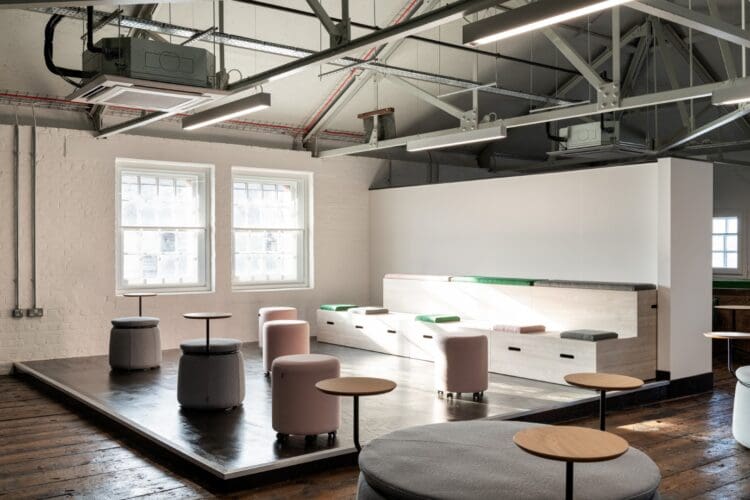 https://www.rapinteriors.co.uk/wp-content/uploads/2024/02/Bleacher-seating-breakout-space-in-office-interior-design-project-1-750x500.jpg
Bleacher seating breakout space in office interior design project. Rap interiors.
https://www.rapinteriors.co.uk/wp-content/uploads/2024/02/Bleacher-seating-breakout-space-in-office-interior-design-project-1-750x500.jpg
Bleacher seating breakout space in office interior design project. Rap interiors.
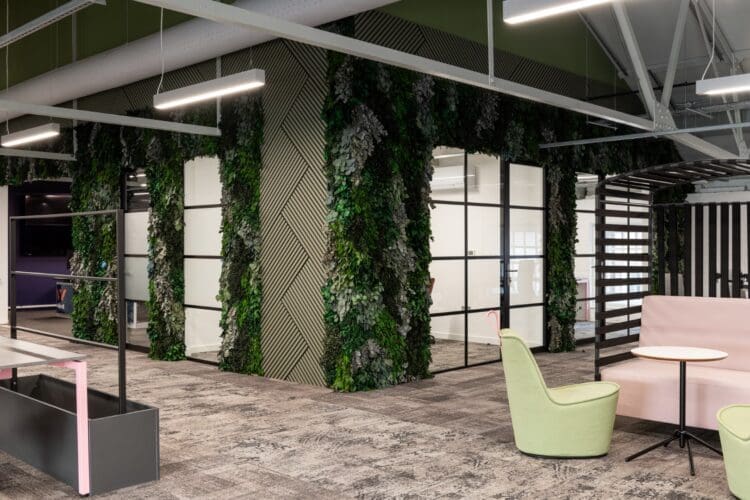 https://www.rapinteriors.co.uk/wp-content/uploads/2024/02/Large-biophilic-feature-wall-with-preserved-foliage-and-olive-green-slatted-timber-750x500.jpg
Large biophilic feature wall with preserved foliage and olive green slatted timber.
https://www.rapinteriors.co.uk/wp-content/uploads/2024/02/Large-biophilic-feature-wall-with-preserved-foliage-and-olive-green-slatted-timber-750x500.jpg
Large biophilic feature wall with preserved foliage and olive green slatted timber.
As employee expectations have changed, so too have office designs – with particular emphasis on wellbeing. This is highlighted in the Tomorrow’s Office report, which predicts that ‘healthy’ workspace design will be in demand.
The ‘healthy’ office supports physical and mental wellbeing though biophilic design, inclusive layouts that support neurodiversity, and wellness-focused programmes.
Spaces that encourage people to move around will also be a key part of the ‘healthy’ office design. Referred to as ‘vitality spaces’, these include lounge-like breakout areas and cafés, which nudge people to “move, pause and recharge throughout the day.”
A great way to encourage movement is to introduce bleacher seating, as demonstrated by Ward Security in the image above. These offer a place where people can stretch their legs, move to a different location and get some time away from the static workstation.
Related content: How to Boost Team Morale Through Office Design
https://www.rapinteriors.co.uk/wp-content/uploads/2025/09/Future-workspace-design-ideas-750x500.jpg
Future workspace design ideas with future office design trends.
As we’ve mentioned in the point above, wellbeing is going to be a key driver in office fit out decisions moving forward. Now, it seems virtual reality could start making its way into designs as part of a push to create healthier workspaces.
Indeed, Worktech Academy and Science Direct recently featured Bio.Pod, which is a virtual reality environment that provides users with natural scenes and sounds. This simulates natural settings to promote emotional and physiological recovery after stressful situations.
The question is, can a virtual reality environment have the same impact on wellbeing as a walk in the great outdoors? An experimental study from the Department of General Psychology suggests it can.
After 150 young adults were assessed, the results showed that the virtual environments demonstrated a positive impact on stress recovery. The ‘Bio.Pod with Nature View’ was particularly successful, having produced a slower heart rate amongst participants – a sign of relaxation.
Arguably, the most significant trend is the focus on creating meaningful spaces. With businesses investing in ‘heritage’ buildings, making ties with the past will be as important as adopting future trends. In essence, this will be about embracing authenticity to inspire employees.
Conversely, virtual biophilia takes a step towards the future in the true sense of the word. With research showing that virtual reality can enhance wellbeing, this invention could be the start of a significant trend in the world of workplace tech.
In addition to meaningful spaces and tech developments, the future of office design is still focused on versatile layouts with more choice. This points towards a shift away from generic layouts and towards designs that prioritise employee wellbeing and adaptability.
Looking to transform your workspace? Don’t get left behind! Our team of workspace design and build experts can help you create a space that’s ready for the future with our office fit out services.
Please call 0333 600 1234 or fill out the enquiry form below to arrange a consultation.
Enter your details below and one of the team will contact you to discuss your requirements.
 https://www.rapinteriors.co.uk/wp-content/uploads/2022/01/Office-boardroom-interior-design-for-a-Kent-property-developer-750x1125.jpg
Workspace interior design with acoustic elements
https://www.rapinteriors.co.uk/wp-content/uploads/2022/01/Office-boardroom-interior-design-for-a-Kent-property-developer-750x1125.jpg
Workspace interior design with acoustic elements