

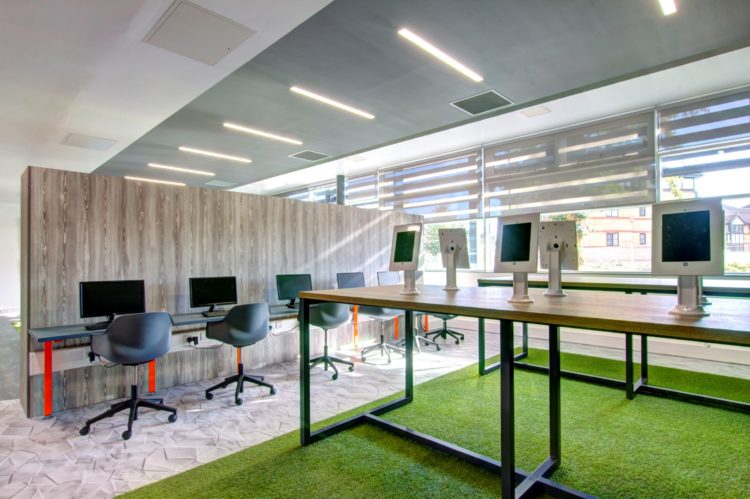
 https://www.rapinteriors.co.uk/wp-content/uploads/2019/05/modern-school-interiors-with-tablet-computers-and-standing-desks-750x499.jpg
Haringey Sixth Form College in London – ICT Classroom Furniture and Fit Out Project by Rap Interiors
https://www.rapinteriors.co.uk/wp-content/uploads/2019/05/modern-school-interiors-with-tablet-computers-and-standing-desks-750x499.jpg
Haringey Sixth Form College in London – ICT Classroom Furniture and Fit Out Project by Rap Interiors
A school interior design scheme can play a key role in helping students to unlock their full potential. When done right, it can help to make learning an enjoyable and enduring experience that will give kids the best possible chance of succeeding in life.
School design can have a big impact on teachers’ lives too. With advances in modern technology, teachers can really bring education to life for students, while a few changes to the staffroom design can go a long way in reducing stress levels!
In this blog, we look at some of the interior design trends that are helping to make school life better for students and teachers alike. From modern technology to colour psychology, you will find plenty of inspiration in our list for 2021.
Read on to find out more.
 https://www.rapinteriors.co.uk/wp-content/uploads/2019/05/a-modern-serving-counter-design-with-a-nelson-mandela-wall-vinyl-3-750x499.jpg
a modern serving counter design with a nelson mandela wall vinyl
https://www.rapinteriors.co.uk/wp-content/uploads/2019/05/a-modern-serving-counter-design-with-a-nelson-mandela-wall-vinyl-3-750x499.jpg
a modern serving counter design with a nelson mandela wall vinyl
A school’s culture and identity can be infused into its interiors to make for an eye-catching and fitting design scheme. As we’ve seen in our previous projects, there are a number of creative ways to do this, including the following:
 https://www.rapinteriors.co.uk/wp-content/uploads/2019/04/london-junior-school-library-fit-out-with-tree-by-rap-interiors-2-1-750x563.jpg
London junior school library fit out with tree by Rap Interiors
https://www.rapinteriors.co.uk/wp-content/uploads/2019/04/london-junior-school-library-fit-out-with-tree-by-rap-interiors-2-1-750x563.jpg
London junior school library fit out with tree by Rap Interiors
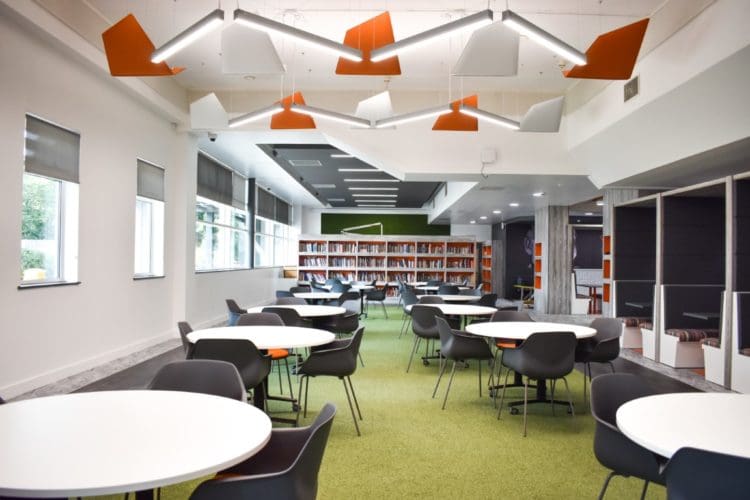 https://www.rapinteriors.co.uk/wp-content/uploads/2019/05/Haringey-sixth-form-learning-centre-breakout-space-750x500.jpg
Haringey Sixth Form learning centre with furniture
https://www.rapinteriors.co.uk/wp-content/uploads/2019/05/Haringey-sixth-form-learning-centre-breakout-space-750x500.jpg
Haringey Sixth Form learning centre with furniture
 https://www.rapinteriors.co.uk/wp-content/uploads/2019/05/a-completed-school-refurbishment-with-a-reading-area-and-a-yellow-wall-with-printed-school-logo-1-750x500.jpg
a completed school refurbishment with a reading area and a yellow wall with printed school logo
https://www.rapinteriors.co.uk/wp-content/uploads/2019/05/a-completed-school-refurbishment-with-a-reading-area-and-a-yellow-wall-with-printed-school-logo-1-750x500.jpg
a completed school refurbishment with a reading area and a yellow wall with printed school logo
Students’ mental health is something that must be taken seriously. These days, the pressures of exams are greater than ever, while more technology has meant that young people are exposed to a number of risks online, including cyberbullying.
With this in mind, here are a few things schools can do to improve mental health in young people:
The aforementioned statistics also revealed that 75% of mental illnesses start before a child reaches their 18th birthday. Therefore, it’s hugely important to make the education environment as sympathetic as possible to this and ensure coming to school is an enriching experience.
 https://www.rapinteriors.co.uk/wp-content/uploads/2019/05/modern-school-interiors-with-tablet-computers-and-standing-desks-1-750x499.jpg
Modern school interiors with tablet computers and standing desks
https://www.rapinteriors.co.uk/wp-content/uploads/2019/05/modern-school-interiors-with-tablet-computers-and-standing-desks-1-750x499.jpg
Modern school interiors with tablet computers and standing desks
Keeping up with new technology is an excellent way to enhance a child’s learning experience, and given that children are digital natives, it makes sense to introduce technology that will help to engage them in study.
Some schools make learning more fun for students by introducing portable devices like iPads and digital textbooks, which are often complemented by storage ports and furniture appropriate for group settings (something we will look at later).
Teachers can also benefit from technology in the form of interactive whiteboards, known as “smartboards”. Smartboards allow teachers to project an image and interact with it by writing on it or moving it around. While the smartboard is a touch screen device, notes can be made using special pens which come in a range of colours.
Want to see something cool? Take a look at how we introduced a table with integrated touch screen devices in one of our latest school projects here.
 https://www.rapinteriors.co.uk/wp-content/uploads/2019/06/the-haringey-sixth-form-school-breakout-area-interior-design-with-booths-and-acoustic-panels-6-750x500.jpg
Haringey Sixth Form College - Fit Out and Refurbishment Project in London - Rap Interiors - Leading UK Refurbishment Contractors
https://www.rapinteriors.co.uk/wp-content/uploads/2019/06/the-haringey-sixth-form-school-breakout-area-interior-design-with-booths-and-acoustic-panels-6-750x500.jpg
Haringey Sixth Form College - Fit Out and Refurbishment Project in London - Rap Interiors - Leading UK Refurbishment Contractors
In recent years, schools have started to introduce handy, easy-to-move furniture into their classroom setups. This includes versatile pieces like modular seating, lightweight tables, wheelable chairs, and even giant bean bags.
The benefit of flexible school furniture is that it can be easily reconfigured to suit different study groups and tasks. This is particularly useful for older education groups like sixth formers, where they are likely to do more work in group settings.
Flexible furniture also complements the technology-led classroom, where portable devices used on a daily basis. A truly efficient space will also have plenty of power sources and outlets to ensure no one runs out of battery mid-task!
For school furniture inspiration, take a look at our projects here.
 https://www.rapinteriors.co.uk/wp-content/uploads/2018/05/a-school-staffroom-with-a-tea-point-designed-by-fit-out-company-rap-interiors-750x563.jpg
According to a recent study, teachers are more likely to suffer job-related stress than other professionals. Furthermore, one in five teachers feel tense about their job all or most of the time compared to one in eight workers in similar professions.
One way to help mitigate the stress factor is to create a relaxing, inviting staff room. In our recent projects, we’ve helped schools by introducing tea points and dining facilities, comfortable furniture like sofas, calming colours, relaxing wall murals, breakfast bars, and modern lighting solutions such as hanging pendants.
The concept of a relaxing staffroom is nothing new of course, but with the rise in stress among teachers, it makes our list of school interior design trends for 2021.
 https://www.rapinteriors.co.uk/wp-content/uploads/2019/05/a-bright-and-modern-desk-situated-in-the-st-mary-magdalene-academy-reception-area-6-750x499.jpg
School Reception Desk at St Mary Magdalene Academy in London
https://www.rapinteriors.co.uk/wp-content/uploads/2019/05/a-bright-and-modern-desk-situated-in-the-st-mary-magdalene-academy-reception-area-6-750x499.jpg
School Reception Desk at St Mary Magdalene Academy in London
More often than not, a school reception area is just a place you go to for information. Visually, they look pretty straightforward, with a desk, a hidden office space and maybe a few decorations to make the space look pretty.
While many schools still overlook the aesthetic aspects of a space, others are starting to take the “first impressions are everything” stance and making a big effort with their designs. For example, we recently transformed St Mary Magdalene’s reception area with a dazzling light-up desk that makes it impossible for visitors to get lost.
Additionally, we added in a glass partition with the school’s emblem to establish a sense of identity and meet safety regulations.
 https://www.rapinteriors.co.uk/wp-content/uploads/2019/06/a-school-space-design-with-yellow-chairs-and-whiteboard-750x499.jpg
Holy Trinity Lamorbey in London – Classroom Refurbishment Project by Rap Interiors
https://www.rapinteriors.co.uk/wp-content/uploads/2019/06/a-school-space-design-with-yellow-chairs-and-whiteboard-750x499.jpg
Holy Trinity Lamorbey in London – Classroom Refurbishment Project by Rap Interiors
As we’ve looked at in our previous blogs, colour psychology can have an impact on a child’s learning abilities and behaviour. With this in mind, it’s important that you take colour psychology into account when refurbishing your interiors.
Here are some guidelines from the book “Colour, Environment and Human Response”, which helps schools to choose colours based on age and academic environment:
Before you go and splash blue on every single wall, it’s worth noting that too much of one colour can have an adverse effect. For example, too much blue can invoke feelings of depression or sorrow, while too much yellow can make students feel stressed. Therefore, it’s a good idea to combine them with other complementary colours to ensure they are effective.
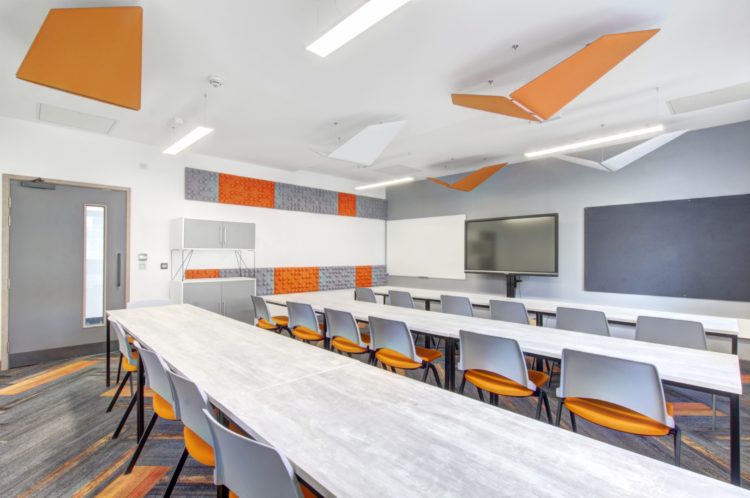 https://www.rapinteriors.co.uk/wp-content/uploads/2020/04/school-classroom-refurbishment-tottenham-750x498.jpg
Laptop Station Interior Design for Haringey Sixth Form College in London – Rap Interiors – Interior Design Company
https://www.rapinteriors.co.uk/wp-content/uploads/2020/04/school-classroom-refurbishment-tottenham-750x498.jpg
Laptop Station Interior Design for Haringey Sixth Form College in London – Rap Interiors – Interior Design Company
Schools can be noisy places, so introducing acoustic elements that reduce noise pollution are a godsend to teachers.
These days, you even can buy fun acoustic solutions that complement the interior design scheme. For example, in our recent project for Haringey Sixth Form College, we introduced V-shaped hanging acoustics that look like flying birds and panels shaped like Lego.
For an added touch, they were designed in colours that reflect the school’s branding.
We hope our blog has given you some bright ideas for your future school interior design.
While COVID-19 may have meant students and teachers have been at home in 2020, there’s nothing to stop you planning for 2021 and beyond. In fact, while the schools are quiet, now might be a good time to re-imagine your interior design scheme. In doing so, you can make the education environment an incredible place when students and teachers return.
Are You in Need of a School Refurbishment Company?
If this blog has inspired you to make changes to your school interior design scheme, then Rap Interiors can help.
For over 30 years Rap has helped countless schools and higher education providers to transform their interiors, ensuring that students and teachers get the best possible experience from their environment.
To book a free consultation, call 0333 600 1234 or email refurb@rapinteriors.co.uk.
https://www.rapinteriors.co.uk/wp-content/uploads/2019/05/modern-school-interiors-with-tablet-computers-and-standing-desks-1-750x499.jpg
Modern school interiors with tablet computers and standing desks