

 https://www.rapinteriors.co.uk/wp-content/uploads/2024/10/Modern-London-office-refurbishment-with-wooden-flooring-and-wood-slat-feature-wall-750x563.jpeg
Modern office refurbishment London, with wooden flooring and wood slat feature wall.
https://www.rapinteriors.co.uk/wp-content/uploads/2024/10/Modern-London-office-refurbishment-with-wooden-flooring-and-wood-slat-feature-wall-750x563.jpeg
Modern office refurbishment London, with wooden flooring and wood slat feature wall.
Fit Out, Refurbishment | Kent, London
The refurbishment company you choose matters more than any other decision in your project. A good contractor turns a disruptive process into a managed one. A poor choice extends your timeline and delivers a space that falls short of what you paid for.
This guide covers the eight questions worth asking before you commit, and the warning signs to watch for during tendering.
In this guide:Eight questions to ask any contractor · Warning signs during tendering · What the contract should cover · Working in an occupied office · Choosing a contractor for London or Kent · FAQs |
Most companies invite two or three companies to tender. The pricing will be similar between credible contractors. These questions help you assess the things that pricing cannot.
Years in business is a proxy for problem-solving experience. An office refurbishment contractor who has been trading for a decade has encountered the structural surprises and coordination issues that newer firms have not. Ask for two or three client references from projects completed in the last 18 months, and call them. A contractor confident in their work will hand you the numbers without hesitation.
Rap Interiors has been refurbishing commercial spaces since 1988. In 2025, 62% of our projects came from repeat clients or their referrals. We will always put you in contact with our recent clients.
Ask this early, and pay attention to the answer. Some contractors use a senior project manager to win the work, then hand it to a junior once the contract is signed. You want to know the name of the person who will be on site and reachable throughout your project.
A dedicated project manager, with a single phone number and clear accountability, is one of the clearest marks of a professional operation.
The difference between a fixed-price contract and a provisional sum estimate can run to tens of thousands of pounds on a mid-size refurbishment. Ask the contractor to explain every line item on their quote, and ask which figures are firm and which are subject to change. Any contractor who cannot explain the basis of their pricing clearly is not ready to start your project.
A detailed, itemised quote is also your baseline for managing the project. If a variation is raised during the build, you have something to measure it against.
A London office in a multi-tenanted commercial building has specific constraints that a contractor unfamiliar with the city may not have encountered: delivery restrictions, out-of-hours working requirements, building management sign-off on methods and materials, and strict rules on noise and vibration during core hours. A contractor who has worked across London will have established relationships with building managers and know how to programme around these constraints.
For projects in Kent, the logistics are different but the principle is the same. A contractor with an established local presence can respond quickly and is not adding a long-distance premium to every site visit.
Variations, changes to the agreed scope after work has started, are where many refurbishment projects run into difficulty. Ask the contractor to walk you through their variation process. You want a clear written procedure: a variation quotation is raised and signed off by both parties before undertaking any additional works . Verbal agreement should always be followed up by written confirmation so to avoid any surprise invoices at the end of a project
Relevant accreditations include Constructionline, CHAS (Contractors Health and Safety Assessment Scheme), and membership of the National Federation of Builders. They indicate that a contractor maintains minimum standards on health, safety and insurance. Ask to see current certificates, not just logos on a website.
ISO accreditation, particularly ISO 9001, shows that a contractor follows independently audited business processes designed to maintain quality, consistency and continual improvement across its operations.
Industry award wins matter too. Rap Interiors won NFB Refurbishment of the Year and the Build Award for Best Office Interior Design. Awards matter because they involve external assessment of completed work by people who know the industry.
If your team is staying in the office during the refurbishment, ask the contractor how they plan to contain dust and noise. Additional health and safety measures would need to be put in place if a client is going to retain occupancy. A phased programme and a clear division between site and office setting needs to be defined and managed.
Weekly updates to staff are the basics of managing an occupied office project. Contractors who have done this before will have a standard approach.
If you are refurbishing leased space, your lease likely includes dilapidations obligations, requirements to return the space to its original condition at the end of the term. A contractor who handles dilapidations work can advise you at the design stage on which elements of your refurbishment will need to be reinstated, and can factor that into your long-term cost planning. Dealing with dilapidations at lease end, is almost always more expensive than planning for them upfront.
The tender process tells you more about a contractor than their brochure does. These are the signs that matter.
If one contractor comes in 25% below the rest, they have either misunderstood the scope or priced it low to win the job with the intention of recovering margin through variations. Either way, it rarely ends well. The cheapest quote and the lowest final cost are rarely the same thing.
A contractor who deflects or delays when asked for client references is telling you something. A strong track record is the easiest selling point a contractor has. Reluctance to share it almost always means the references are not there.
Legitimate contractors do not need to rush you into a decision. Pressure to commit before you have had time to check references, review the contract, or get a second opinion is a tactic, not a deadline. However, your contractor may set reasonable deadlines for approvals and decisions to maintain programme schedules, accommodate lead times, and ensure efficient project delivery.
The contract is your protection. Before you sign anything, check that it clearly sets out the following.
A company should have experience working under a JCT and be happy to carry out this form of contract. However, your contractor may have their own thorough T&Cs for you to review and agree to. In some instances the basis of a JCT can be formed from the contractors own T&Cs.
| A note on design and build:
Many clients find it simpler to appoint a single contractor who handles both the design and the build under one contract. This gives you a single point of accountability, reduces the risk of gaps between design intent and construction reality, and often results in a faster programme. Rap Interiors works on a design-and-build basis as standard. |
London adds a layer of complexity to any refurbishment project that clients outside the capital sometimes underestimate.
Most commercial buildings in central and inner London have delivery restrictions: permitted hours and advance notice to building management. Skips and waste removal need to be licensed, and parking suspensions booked. Working outside normal hours, when the building is quiet and your team is not affected, carries a premium for labour but is often the right call for intensive phases of work.
The contractor’s relationship with the building management team matters. A contractor who has worked in similar buildings, who knows the process for getting methods-of-working approved, and who treats the building manager as a stakeholder rather than an obstacle runs a considerably smoother project. Ask your prospective contractors how they typically manage this relationship.
For businesses in Kent, Maidstone, Sevenoaks, Tonbridge, and the surrounding areas, the choice of contractor includes a straightforward geographic question: does it make sense to appoint a London firm, or a contractor with a genuine local presence?
The practical argument for local is strong. Site visits cost less time and money when the contractor’s team is 20 minutes away rather than two hours. Subcontractors are drawn from the local supply chain, with established relationships and a shared interest in maintaining a good local reputation. If something unexpected comes up on site, the contractor responds in hours rather than days.
Rap Interiors has its headquarters in Maidstone. We have been working with Kent businesses since 1988. We know the local commercial property market and the kinds of spaces businesses in the region occupy. That familiarity reduces friction throughout a project.
Discuss your refurbishment with our team:We work with businesses across London, Kent, Brighton, and the South East on office refurbishments of all sizes, from a single-floor refresh to a full multi-phased programme. Contact us to arrange a free initial consultation. Please call 0333 600 1234, email refurb@rapinteriorsco.uk or fill out the enquiry form below. |
The cost depends on the size and specification of the space. As a rough guide for 2026: a light cosmetic refurbishment runs from £40 to £60 per square foot; a mid-range refurbishment with layout changes and upgraded services from £65 to £95 per square foot; a high-specification project from £95 upward. For an accurate figure, the best starting point is a site visit and a detailed brief. Our guide to office fit out and refurbishment costs covers the main variables in more detail.
Every project is unique, and refurbishment timescales can vary significantly. Smaller-scale works will naturally take less time than larger, more complex projects. Larger or more complex projects, particularly those phased around an occupied workplace, will take longer.
To give you a general indication of timescales, we have included a selection of recent projects below:
Corporate Insurance Company, Kings Hill – Size: 5,320 ft² | Time: 4 months
Hudl – Size: 4,200 ft² | Time: 3 months
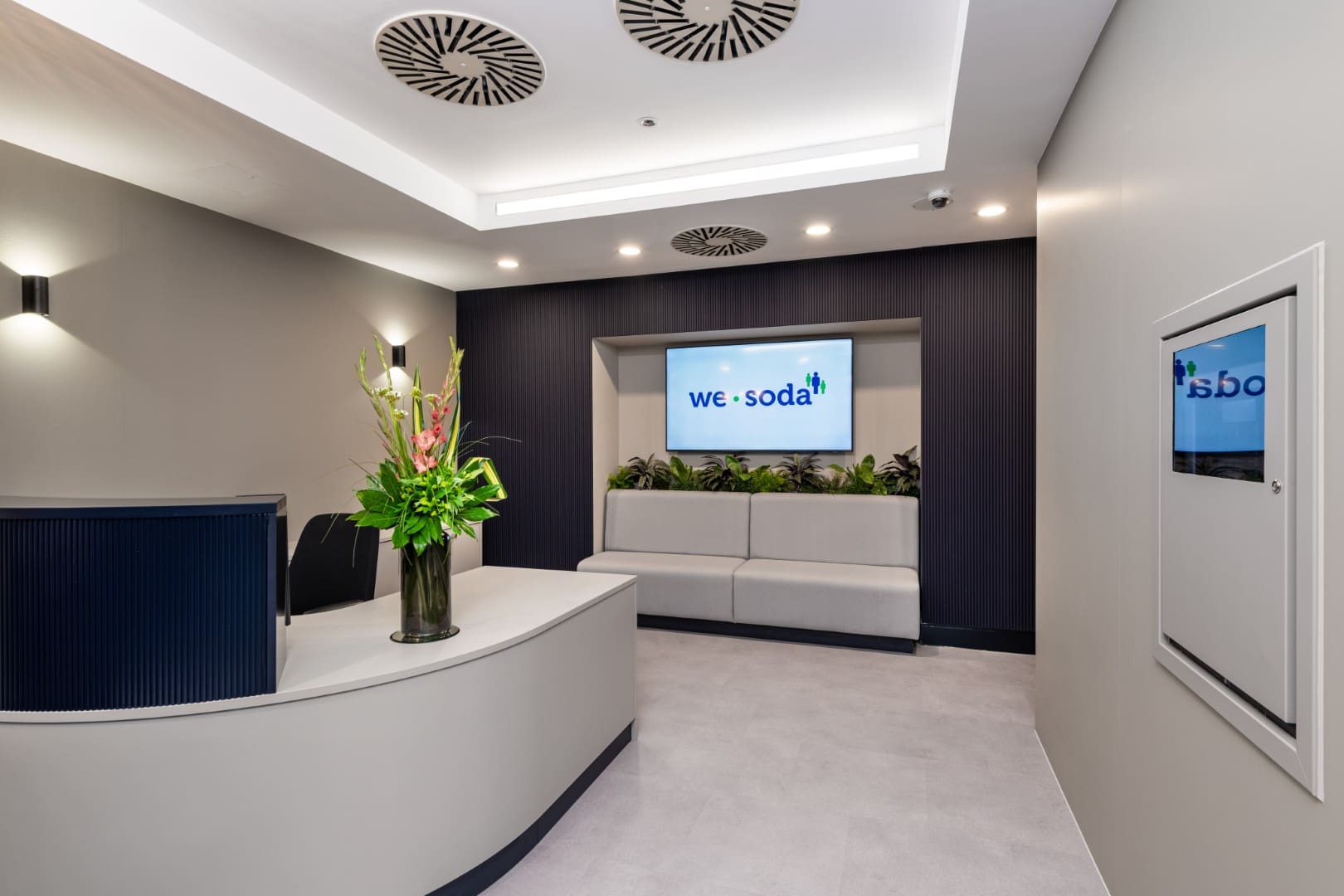
We Soda – Size: 3,800 ft² | Time: 7 weeks
Vestey – Size: 2,000 ft² | Time: 4 weeks
Other factors can also affect programme duration. For example, whether the office remains occupied during the works may influence scheduling, phasing and access arrangements. Lead times for commercial-grade furniture should also be considered during the planning stage, as these can be substantial. Standard items such as desks often have lead times of five to seven weeks, while bespoke furniture and certain soft seating products can take eight weeks or more.
To maximise your options and help ensure a smooth delivery, it is advisable to begin the planning process as early as possible before your target completion date.
For many projects, yes. A phased programme divides the floor plate into sections, refurbishing one area while the rest remains operational. The contractor manages dust and noise at the boundary between the two zones. For projects involving significant structural work or full floor replanning, a temporary relocation is sometimes the cleaner option. We will advise you honestly on which approach suits your specific situation.
It is worth noting, however, that a phased approach may increase overall project costs. Subcontractors completing specific elements of the works may need to make multiple visits to site, resulting in additional labour, travel and management costs. Clients should therefore carefully weigh the benefits of reduced disruption and business continuity against the additional expense associated with a phased refurbishment programme.
A fit out typically refers to the process of preparing a space for first occupation, starting from a shell or stripped floor plate and building it out to a finished standard. A refurbishment works with an existing fitted space, improving or reconfiguring it rather than starting from scratch. In practice, many projects combine both: removing existing elements and rebuilding them to a higher standard. Our guide to office fit out and refurbishment covers both in depth.
Yes. Rap Interiors has its headquarters in Maidstone and offices in London, Brighton, and Croydon. We work with businesses across Kent, the South East, and London. Being locally based enables us to provide a responsive service and arrange site visits within a timescale that suits your project requirements.
Yes. We offer a full dilapidations service, covering assessment of your lease obligations and the physical works required at handback. Managing dilapidations alongside your refurbishment, rather than treating them separately at lease end, almost always reduces the total cost. In order to ensure a smooth and accurate project quotation, clients should look to obtain a dilapidation schedule from the landlord.
Rap Interiors holds Constructionline Gold accreditation and is Safecontractor approved.. We are members of the Finishes and Interiors Sector and ISO 9001 certified. We have won the NFB Refurbishment of the Year award and the Build Award for Best Office Interior Design. Our team is fully trained in current health and safety legislation including CDM regulations.
Enter your details below and one of the team will contact you to discuss your requirements.
 https://www.rapinteriors.co.uk/wp-content/uploads/2022/01/Office-boardroom-interior-design-for-a-Kent-property-developer-750x1125.jpg
Workspace interior design with acoustic elements
https://www.rapinteriors.co.uk/wp-content/uploads/2022/01/Office-boardroom-interior-design-for-a-Kent-property-developer-750x1125.jpg
Workspace interior design with acoustic elements