
 https://www.rapinteriors.co.uk/wp-content/uploads/2021/04/back-to-the-future-delorean-1-750x456.jpg
Back to the future car
https://www.rapinteriors.co.uk/wp-content/uploads/2021/04/back-to-the-future-delorean-1-750x456.jpg
Back to the future car
After over a year of working from home, it appears that the great return to the office is finally on the horizon. With the roadmap on track and lockdown measures easing, the UK is moving in the right direction, and such is the progress that Chancellor Rishi Sunak has weighed in with a back-to-work message to businesses.
Looking beyond the pandemic, Sunak spoke about the benefits of working in the office to encourage employers to open their doors again. “You can’t beat the spontaneity, the team building, the culture that you create in a firm or an organisation from people actually spending physical time together, ” Sunak said in an interview with Sky News.
He went on to warn bosses that those who shut their offices risk losing staff who will “vote with their feet” and defect to a company that offers a desk. Indeed, it’s likely that those who have been paying a premium to live close to work will be frustrated by the prospect of working from home full time. Equally, many employees simply prefer the office environment for more reasons than simply doing work (more on this later).
With the return to the office in sight, we look into what employees have missed and how businesses can optimise their spaces to make them even better than before. From furniture tips to breakout area ideas and more, you’ll find plenty of inspiration here.
Read on for some great forward-thinking workspace design ideas …
 https://www.rapinteriors.co.uk/wp-content/uploads/2020/12/microsofts-branding-colours-office-interior-design-750x562.jpg
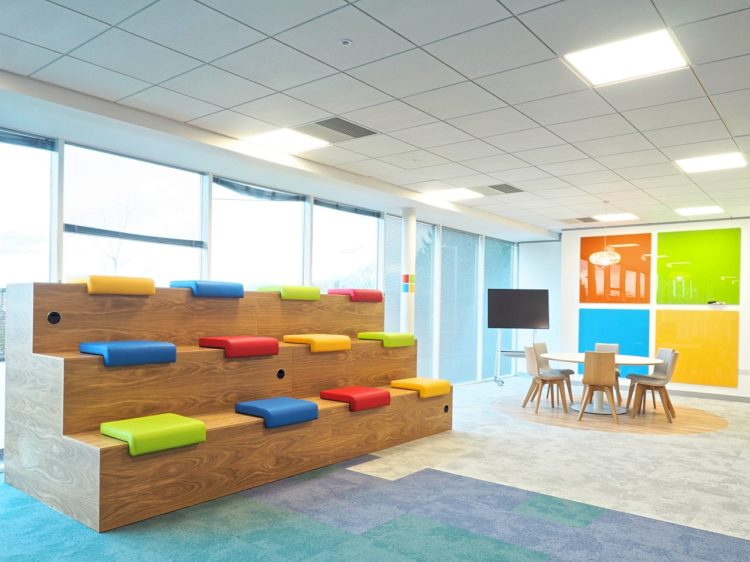
Bleacher seating with Microsoft branding coloured seat pads in an office breakout area
https://www.rapinteriors.co.uk/wp-content/uploads/2020/12/microsofts-branding-colours-office-interior-design-750x562.jpg
Bleacher seating with Microsoft branding coloured seat pads in an office breakout area
During Sunak’s interview, he also discussed the importance of the office for employee development. “Imagine you’ve just left college or university; you start this job in a big company and you’re sitting at home on your own,” he said. “How do you get to know your peers, how do you learn the culture of an organisation, how do you get those mentors, which are important for your career development?”
This notion is supported by a survey by the British Council of Offices (BCO), which found that seven out of 10 workers said the office was important for learning and developing networks. Furthermore, two-thirds said their career had been helped by relationships made in the office.
To increase your chances of keeping hold of ambitious employees, consider introducing a dedicated space for training and mentoring. This may be a meeting room with an electronic booking system, a plug and play workstation accompanied by a mobile whiteboard or monitor, or bleacher seating pointing towards a presentation screen. Whatever setup you decide to use, it’s important to promote the fact that your business supports training and mentoring. Presenting a dedicated space will highlight this in a tangible way.
In XMA’s London Head Office, a collaborative workspace was refurbished with a variety of seating and built-in power points, perfect for training staff and clients to demonstrate the capabilities of the latest Microsoft Surface devices. Read more details about this office refurbishment project here.
According to a survey by Indeed on the work-from-home experience, 73% of employees miss socialising in person with colleagues. Clearly, video technology hasn’t been able to reproduce the social experience of talking at the water cooler, working side-by-side or meeting at lunch. For those employees who have missed the social aspect of office life, introducing spaces dedicated to mixing with colleagues will be a welcome addition.
Here are a few ideas:
Looking for more office design ideas? Take a look at the latest Office Design Trends for 2021 here.
 https://www.rapinteriors.co.uk/wp-content/uploads/2021/10/Glass-fronted-soundproof-booth-installed-for-an-office-fit-out-project-750x500.jpg
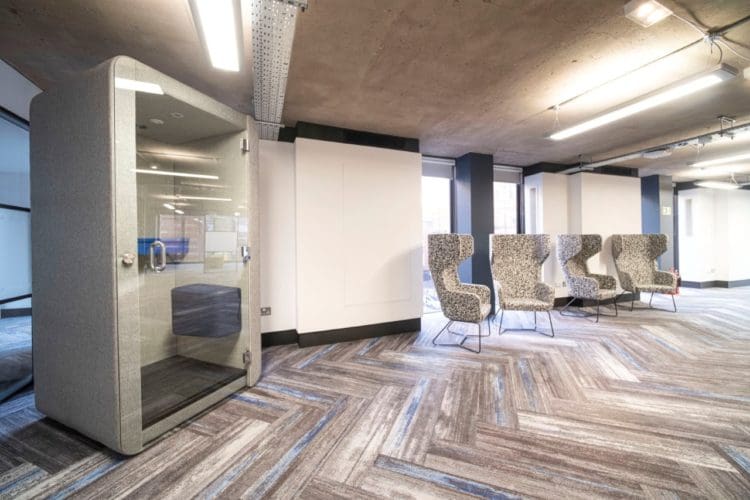
Glass fronted soundproof booth installed for an office fit out project
https://www.rapinteriors.co.uk/wp-content/uploads/2021/10/Glass-fronted-soundproof-booth-installed-for-an-office-fit-out-project-750x500.jpg
Glass fronted soundproof booth installed for an office fit out project
The Indeed survey also revealed that 64% miss fewer distractions at the office compared to working from home. This is interesting data, as one might assume that working from home would offer fewer distractions.
Given that this is the case, there’s no harm in introducing a few extra elements to reduce distractions in the workplace. For example, you can get wall panels that reduce noise pollution, soundproof pods for independent working, and private booths for phone calls and video chats. Some offices even offer “quiet areas” where employees can double down on tasks. These are ideal for those working to tight deadlines and who need to get away from chatty colleagues!
 https://www.rapinteriors.co.uk/wp-content/uploads/2021/04/engie-impact-meeting-booths-750x562.jpg
engie-impact-glass-faced-meeting-booths
https://www.rapinteriors.co.uk/wp-content/uploads/2021/04/engie-impact-meeting-booths-750x562.jpg
engie-impact-glass-faced-meeting-booths
There has been a lot of talk about companies offering the option of flexible working to employees on a full-time basis. For many, this will be completely new and may take some to get right. With portable and customisable office furniture, you can reconfigure the design to adapt to the needs of your employees. Equally, your employees can move the elements around to enable them to perform specific tasks.
Alternatively, consider consulting the help of a professional office design company for expert space planning advice. Here are a few examples where can change things up with ease and develop a layout that maximises productivity:
 https://www.rapinteriors.co.uk/wp-content/uploads/2019/11/The-Pick-Everard-London-office-fit-out-in-Holborn-750x500.jpg
The Pick Everard London office fit out in Holborn
https://www.rapinteriors.co.uk/wp-content/uploads/2019/11/The-Pick-Everard-London-office-fit-out-in-Holborn-750x500.jpg
The Pick Everard London office fit out in Holborn
Let’s face it, video technology just isn’t the same as face-to-face collaboration. It can be hard to pick up on visual cues and battling with malfunctioning technology is enough to make you want to pull your hair out.
As collaboration has been more of a challenge during the pandemic, employees will value changes to workplace interiors that facilitate team tasks. This will be especially important for companies transitioning into flexible working, as the office will provide the space where important meetings can be held and creative ideas shared.
The modern way to do this is to create an agile space where employees can “plug in and play” with their devices. For example, you could introduce shared meeting tables with integrated power, pods for two or more people, and lounge areas with nearby plug sockets for laptops.
If you’re thinking about making changes before returning to the office, our final advice to you is this: speak to your employees.
They will tell you what they’ve missed from working in the office and what they’ve enjoyed about working from home, enabling you to make changes that will improve their overall experience.
By doing so, you may just prevent them from “voting with their feet” and joining a rival company. In fact, you may even attract some bright talents as you make a great return to the office.
Enter your details below and one of the team will contact you to discuss your requirements.
https://www.rapinteriors.co.uk/wp-content/uploads/2021/04/back-to-the-future-delorean-1-750x456.jpg
Back to the future car